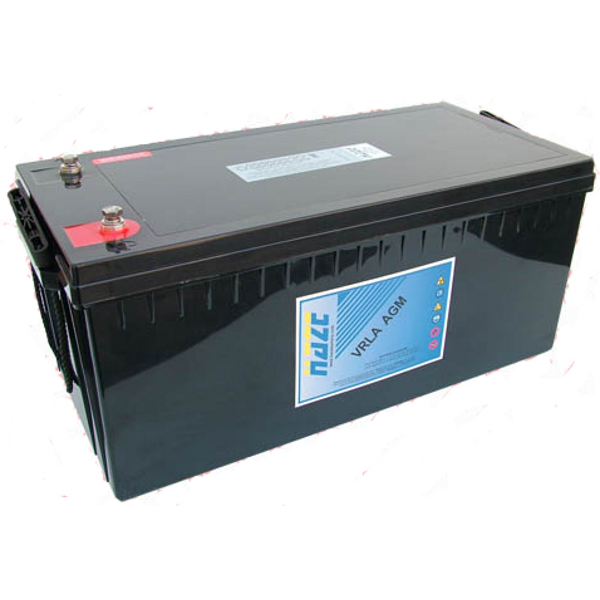
Battery HAZE HZB 12-200
HAZE
Made in China
Key figures
Rated capacity
221 Ah
Nominal voltage
12 V
Weight
61.7 kg
Commercial warranty
24 months
General information
HZB 12-200 · industrial battery · made in Xinfeng, China
Model
HZB 12-200
Battery category
Industrial battery
Economic operator responsible for the passport
LERIA Marcin Socha, ul. Bugno 3, 78-400 Szczecinek, Poland · info@leria.com.pl · www.leria.com.pl · +48 509 816 726 · EORI PL673171828700000
Manufacturer
HAZE POWER COMPANY LIMITED
Manufacturer postal address
Datang Industry Zone, Xinfeng, Ganzhou, Jiangxi, China, 341600
Website
https://hazebattery.com/
Email
custserv@hazebattery.com.cn
Place of manufacture
Xinfeng, Jiangxi, China
Weight (kg)
61.7
Labels and compliance
Separate-collection symbol · Pb symbol
- Passed: Separate-collection symbol (crossed-out bin): Required
- Passed: Cd symbol (cadmium above 0.002 %): Not required
- Passed: Pb symbol (lead above 0.004 %): Required
Chemistry and materials
Lead acid battery · lead above 0.004 %
Battery chemistry
Lead acid battery
Critical raw materials above 0.1 % (Annex X(1))
None
Hazardous substances (other than Hg, Cd, Pb)
Sulphuric acid (electrolyte, CAS 7664-93-9)
- Passed: Cadmium (symbol threshold 0.002 %): Below — no Cd symbol
- Passed: Lead (symbol threshold 0.004 %): Above — Pb symbol required
Usable extinguishing agent
CO2, foam, dry chemical
Renewable content (%)
0
Performance and durability
221 Ah (C10 to 1.75 V/cell) · 12 V nominal · 2.44 kWh
Rated capacity (Ah)
221
Energy (kWh)
2.436
Minimum voltage (V)
10.5
Nominal voltage (V)
12
Maximum voltage (V)
14.4
Temperature range for the voltages
+20 … +25 °C (reference conditions, HAZE EU-2023-1542-PD-001)
Original power capability (W)
6000
Power limits
Original power capability 6000 W: continuous discharge power over 5 minutes at 20 °C to an end voltage of 10.5 V.
Expected lifetime (cycles)
450
Reference test for the lifetime
450 cycles at 50 % DoD, 22 °C, C3 discharge rate, recommended cyclic charging profile (IEC 60896-21/22); calendar life 10 years at 20 °C in float use. Source: HAZE document EU-2023-1542-PD-001 (23 Nov 2026).
C-rate in the cycle-life test, charge
0.25
C-rate in the cycle-life test, discharge
0.33
Temperature range when not in use
+20 … +25 °C
Reference test for the idle temperature range
Idle temperature test, Haze Lab report HAZE-2026112001 (HZB12-200, S/N 33804HZK12): 24 h at rest at 25 °C ambient, casing and terminal temperature within +0.3 °C of ambient, OCV stable 13.09–13.07 V. Result: pass.
Commercial warranty (months)
24
Initial round-trip efficiency (%)
83
Round-trip efficiency at 50 % of cycle life (%)
78
Internal resistance, cell (Ω)
0.00041667
Internal resistance, pack (Ω)
0.0025
State of health and use
Original battery · expected lifetime 10 years
Supply chain
Manufactured in Xinfeng, China
-
ManufactureChina
Circularity and end of life
End-user information (Art. 74) · spare parts via the manufacturer
Spare parts
Contact the manufacturer
Waste prevention and management
Information for end-users under Article 74(1) of Regulation (EU) 2023/1542 (AGM battery).
(a) Preventing waste and extending battery life. Use only chargers or regulators with an AGM profile (voltage control and temperature compensation); avoid overcharging (gassing) and undercharging. Recharge promptly after every discharge to prevent irreversible sulphation of the lead plates. Operate and store the battery in a dry, ventilated place, ideally at room temperature (about 15–25 °C): high temperatures shorten its life, low temperatures reduce capacity and a discharged battery may freeze. If the battery is not used for a long time, store it fully charged and top up the charge every 3–6 months. Respect the discharge currents in the manufacturer's specification. A battery whose capacity has fallen below what the main installation needs (e.g. a UPS, camper or boat) can still safely power simpler, lower-load circuits such as emergency lighting; before discarding it, have a specialist service assess it for further use or reconditioning.
(b) Separate collection. Waste AGM batteries must not be thrown away with mixed municipal waste. As an end-user you must hand the waste battery over for separate collection: free of charge at a retailer (when buying a new battery, or in larger shops selling batteries), at a municipal separate-collection point (PSZOK in Poland) or to an operator collecting waste batteries.
(c) Collection, re-use and recycling. Separately collected AGM batteries go to specialised treatment and recycling plants, where secondary raw materials are recovered — mainly lead, the plastic of the casing and the electrolyte — and return to the economy, including in new batteries. Working or partly worn units can be professionally reconditioned or re-used as stationary energy storage.
(d) Safety when handling waste batteries. Protect the terminals against short circuit (insulating caps or tape): a short circuit can cause sparks, rapid heating, fire or explosion. Do not open, crush or pierce the casing and do not throw the battery into fire; keep it away from heat and open flame. Although the electrolyte is held in glass-fibre mats, a cracked casing can leak corrosive sulphuric acid: carry and store a damaged battery upright in a sealed, acid-resistant container, wearing gloves and safety glasses.
(e) Meaning of the symbols. Crossed-out wheeled bin: the battery must not be disposed of with unsorted municipal waste and must be collected separately. Chemical symbol "Pb" under the bin: the battery contains more than 0.004 % lead by weight (lead-acid battery).
(f) Effect of the substances on the environment and health. The battery contains substances hazardous to the environment and to human health, mainly lead (Pb) and sulphuric acid (H₂SO₄). Improper handling (abandoning it, breaking the casing or burning it) contaminates soil, groundwater and air. Lead is a toxic heavy metal that accumulates in living organisms and can damage the nervous system, blood and kidneys. Sulphuric acid is strongly corrosive, burns skin and eyes and acidifies soil and water. Handing the battery over for recycling removes these risks.
Carbon footprint and recycled content
Need more information?